French Verb Conjugator
Type any French infinitive — être, avoir, aller, or any regular verb — and see it conjugated across every tense and mood.
Enter a French infinitive above to see its conjugations.


Type any French infinitive — être, avoir, aller, or any regular verb — and see it conjugated across every tense and mood.
Enter a French infinitive above to see its conjugations.
The FrenchWrite French verb conjugator generates complete conjugation tables for any French verb you type in. Être, avoir, and 19 other irregular verbs are built in directly, and every regular -er, -ir, and -re verb is conjugated on the fly with the standard pattern rules. Type a verb above and see all nine tenses and moods laid out: présent, imparfait, passé composé, plus-que-parfait, futur simple, futur antérieur, subjonctif présent, conditionnel présent, and impératif présent. It doesn't cover every irregular verb — a few less common ones outside that core list, mostly irregular -ir verbs like dormir or ouvrir, aren't in it yet. Everything runs locally in your browser, with no server calls and no login. For a step-by-step walkthrough, read the French Verb Conjugator guide.
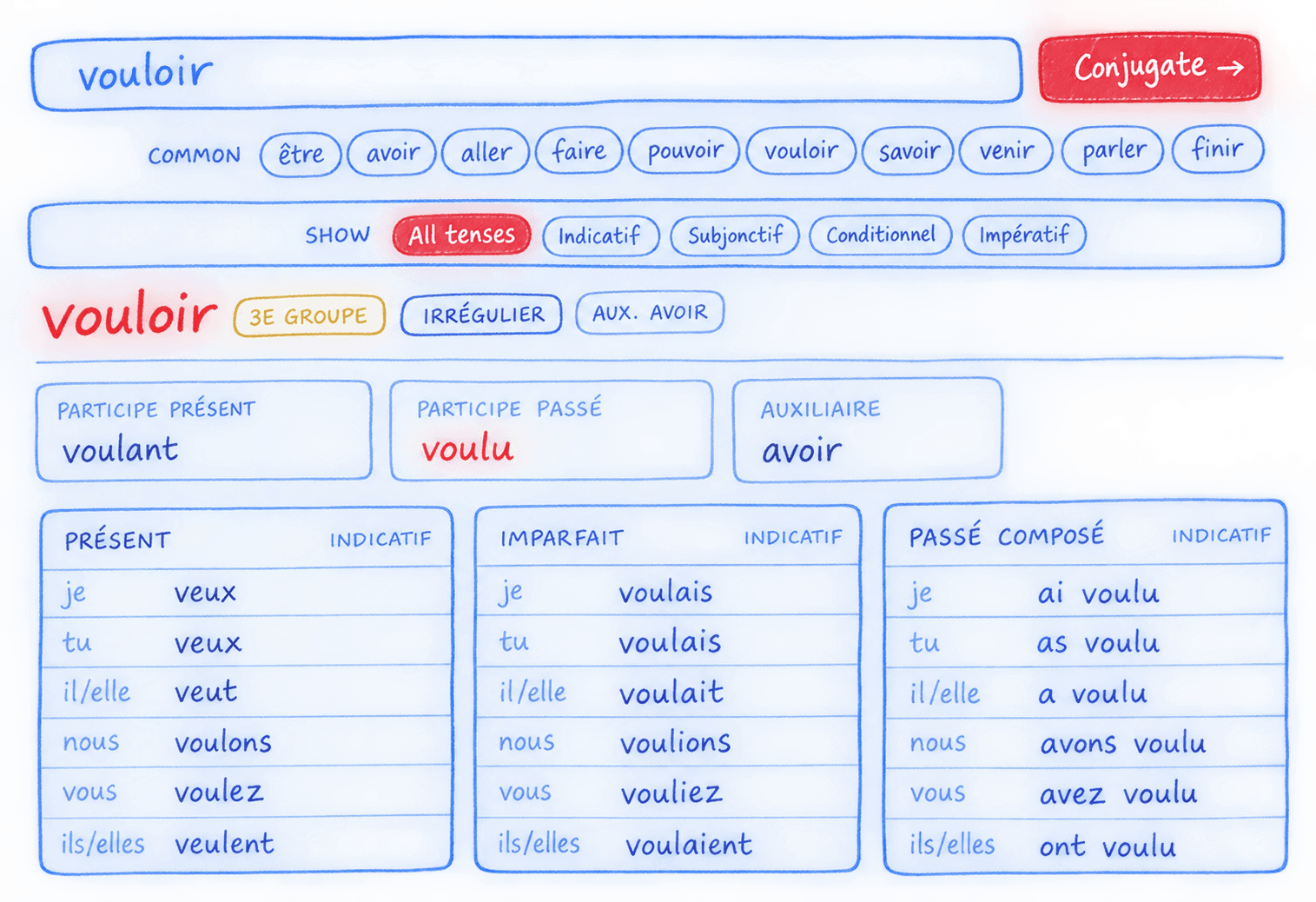
Once a verb's table is open, the mood filter — Indicatif, Subjonctif, Conditionnel, Impératif — narrows the view to just what you need, which matters if you're checking the subjunctive for a DELF B2 opinion essay and don't want to scroll past the six indicatif tenses to find it. Click any single conjugated form to copy just that word, or use Copy All to grab the whole table as plain text and paste it straight into the writing editor to keep drafting. The ten quick-access chips — être, avoir, aller, faire, pouvoir, vouloir, savoir, venir, parler, finir — skip the typing for the verbs you'll look up most.
Need to count words in your writing? Use the French word counter. Not sure whether a noun is le or la? The French gender checker gives you the answer and the suffix rule behind it.
Conjugating a French verb means changing its ending (or adding an auxiliary) to match the subject, the tense and the mood. French verbs fall into two structural types: simple tenses, where the ending itself changes on the verb's own stem (je parle, je parlais, je parlerai), and compound tenses, built from an auxiliary verb (être or avoir) conjugated in a simple tense plus a past participle (j'ai parlé, j'étais allé). Every tense in French belongs to one of these two patterns — once you recognise which one you're dealing with, conjugating becomes a matter of applying the right rule rather than memorising each form from scratch.
Être and avoir aren't just two irregular verbs to memorise — they're the auxiliaries that build every compound tense in French, which is why getting them wrong breaks passé composé, plus-que-parfait and futur antérieur all at once. Avoir is the default auxiliary, used by the vast majority of French verbs (j'ai mangé, tu as fini). Être is used by a small, fixed set of intransitive movement/state verbs — often taught as the "DR & MRS VANDERTRAMP" list (devenir, revenir, monter, rester, sortir, venir, aller, naître, descendre, entrer, rentrer, tomber, retourner, arriver, mourir, partir) — plus every reflexive verb (se lever → je me suis levé).
The two auxiliaries also follow different agreement rules: with être, the past participle agrees in gender and number with the subject (elle est partie, ils sont partis); with avoir, the past participle only agrees with a preceding direct object, not the subject (la lettre qu'il a écrite, but il a écrit une lettre with no agreement). Type être or avoir into the conjugator above to see every tense built from them side by side.
| Group | Ending | Pattern | Examples |
|---|---|---|---|
| 1er groupe | -er | Regular | parler, manger, aimer |
| 2e groupe | -ir | Regular (-iss-) | finir, choisir, grandir |
| 3e groupe | -ir / -re / -oir | Irregular | partir, vendre, voir |
| Auxiliaires | — | Highly irregular | être, avoir |
Of the nine tenses and moods this tool covers, these five carry the most weight in everyday writing and exam tasks:
| Tense | Type | Used for | Example (parler) |
|---|---|---|---|
| Présent | Simple | Current actions, habits, general facts | je parle |
| Passé composé | Compound | Completed past events | j'ai parlé |
| Imparfait | Simple | Ongoing or repeated past states | je parlais |
| Futur simple | Simple | Future actions and plans | je parlerai |
| Subjonctif présent | Simple | Doubt, wish, necessity, emotion | que je parle |
Every one of these — plus the remaining four (plus-que-parfait, futur antérieur, conditionnel présent, impératif présent) — is generated for any verb you type into the tool above.
The tool covers nine tenses and moods: présent, imparfait, passé composé, plus-que-parfait, futur simple, and futur antérieur (all indicatif), plus subjonctif présent, conditionnel présent, and impératif présent. These are the tenses most exam writing tasks — TCF, TEF, DELF, DALF — actually test.
Yes. Irregular verbs — including être, avoir, aller, faire, pouvoir, vouloir, savoir, venir, prendre, mettre and voir — are included with fully correct forms for every tense and mood. The quick-access chips give one-tap access to the most common ones.
Yes, completely free. No account, no subscription, no usage limit. All features — full conjugation tables, tense filter, copy button — are available at no cost.
No. The complete conjugation database is built into the tool and runs entirely in your browser. Nothing you type is sent to any server, and no data is stored or logged.
Click any conjugated form to copy it to your clipboard, or use Copy All to export the full table. Paste directly into the FrenchWrite writing editor, which auto-saves your draft and includes an accent toolbar and word counter for a complete writing session.
La page (of a book) is feminine, but un page (a page-boy) is masculine. The gender changes the meaning. Here is how to tell them apart.
The DELF B2 production écrite most commonly takes the form of a formal letter. Learn the required format, key phrases, and how to hit 250 words with a structure that examiners reward.
Main is feminine: la main, une main. It ends in a consonant but is not masculine. Here is the rule, examples, and the trap to avoid.